Wednesday, September 29, 2004

not-so komical kamikazes


Shigeyoshi Hamazono, 1945

....from They've Outlived the Stigma by Bruce Wallace:

These are the dusky days of old age that kamikaze pilots like Shigeyoshi Hamazono were not supposed to see. Three times during the final months of World War II, Japanese officers sent Hamazono off to die, ordering him to crash-dive a single-engine plane stuffed with bombs into an American warship. Bad weather aborted the first mission, an oil leak the second. On his final attempt in April 1945, he encountered three American pilots over the sea off Okinawa. In the ensuing dogfight, Hamazono was burned and took shrapnel in his shoulder, but his plane limped home. You could call him the luckiest man in Japan, though Hamazono didn't see it that way at the time. "I was, of course, ready to die," says Hamazono, who instead has aged into a bent but dignified 81-year-old. Fate allowed him to see his hair turn wispy and gray. And fate made him part of one of history's strangest and most exclusive brotherhoods: "kamikaze survivors."

Most were still waiting for orders to fly when Japan surrendered to the Allies in September 1945. A few others were spared because they did not reach their intended targets — a failure Hamazono found intolerable at the time. He was on standby to fly a fourth mission when Japan capitulated. Denied the opportunity to redeem his honor, he felt disgraced. "I wished I had died," he says. In the postwar years, a traumatized nation treated the kamikaze survivors like pariahs. But in the last decade, their reputation has recovered. Publishers clamor for memoirs. Scholars pick over their backgrounds in search of an explanation for their willingness to die for a lost cause. Japanese nationalists buff and shine their memory like medals. "Kamikaze" has ceased to be a slur in Japan. If the Japanese still can't agree on whether the pilots were victims or heroes, brainwashed conscripts or volunteers, they are at least prepared to honor their spirit of sacrifice. Only the modern menace of the suicide bomber has emerged to spoil this sentiment. The survivors bitterly resent the world's appropriation of the term "kamikaze" — meaning "divine wind" and originally coined to describe the unexpected typhoons that saved 13th century Japan from invading Mongol ships — as shorthand for suicide bombers of every stripe. There are the "Al Qaeda kamikazes" who flew passenger planes into office towers, "Palestinian kamikazes" who blow up pizza parlors filled with teenagers in Jerusalem, and "female Chechen kamikazes" willing to detonate explosive girdles in the middle of school gymnasiums crammed with children. Japan's originals are insulted to be mentioned in the same breath.

Gravity's Rainbow, p. 690:
Takeshi only had to go to Kamikaze School for two weeks, on Formosa. Ichizo had to go to Ohka school for six months, in Tokyo. There are as different as peanut butter and jelly, these two. No fair asking which is which. They are the only two Kamikazes out here at this air base, which is rather remote actually, on an island that nobody, well, really cares much about, any more.


Tuesday, September 28, 2004


Flag of the State Post Service (Reichs-Postamt), 1893-1921

From Pynchon-l participant, Mark Wright, this pointer to the German postal service flag from the Imperial period, with its Pynchonian-post-horn motif.

Wednesday, September 22, 2004

Pynchon & Coulter

Two names pynchonoid wasn't expecting to hear together (given Pynchon's scorn for the Bush Administration in his post-9-11 Playboy Japan interview and in his introduction for a recent edition of George Orwell's 1984), but there they are, in the context of a Mock Election 2004 debate between right-winger, National Review editor Rich Lowry and left-leaning The Nation editor David Corn, at Pynchon's alma mater:
Referring to conservative Cornellians (Wolfowitz is a 1965 Cornell graduate in mathematics), Corn showed his familiarity with university alumni when he said: "I was accepted at Cornell and nearly attended. Thank you for giving us both Thomas Pynchon and Ann Coulter." (Columnist Coulter, a 1984 graduate of the College of Arts and Sciences, was a founder of the conservative student paper, the Cornell Review. Noted and reclusive author Pynchon, a 1958 graduate, hasn't written for either Review, although he did work briefly as a technical writer for the military aircraft company Boeing.)
Given the way Pynchon depicts Reagan's 1984 America as a country either in the neofascist twilight or already consumed by neofascist night in Vineland, it's debatable that he merits the "conservative" label.


Shell's new premium gasoline carries a name, V-power, that recalls a memorable moment in Mr. Pynchon's best-known novel.

Gravity's Rainbow, p. 241:
"I mean," Slothrop now working himself into a fuss over something that only disturbs him, dimly, nothing to kick up a row over, is it? "doesn't it strike you as just a bit odd, you Shell chaps working on your liquid engine your side of the Channel you know, and their chaps firing their bloody things at you with your own . . . blasted . . . Shell transmitter tower, you see."

Tuesday, September 21, 2004

O when, O when, O when?

The Millions blog engages in a round of bootless speculation about the next Pynchon novel, offering up the various bits and pieces of rumors that have been aired many times on PYNCHON-L. Pynchonoid continues to expect TRP's next in the fall of 2005, according to a little bird who knows.

Monday, September 20, 2004

the Shadow that has just gathered you in its sweep


U-2 photo of Cuban missiles, USAF Museum


From a review of Alice L. George's Awaiting Armageddon: How Americans Faced the Cuban Missile Crisis:
She then examines the United States's civil defense preparations for nuclear war. In such an event, the President, his Cabinet, and the Supreme Court justices could find shelter in Mount Weather, a massive underground complex, 48 miles from Washington, lavishly equipped with offices, a hospital, dining and recreation areas, and sleeping quarters. Congressmen had the benefit of their own bunker, located in West Virginia. Inevitably, the general public was not so well served, because in the 1950s neither the Eisenhower administration nor Congress had shown much zeal for a major outlay for civil defense. Planning was also haphazard at the state and local levels.

As a result of the Berlin crisis of 1961, the Kennedy administration increased spending on public shelters, but support for civil defense measures declined soon after. By the time of the Cuban Missile Crisis, existing shelters could only house about 60 million people--about a third of the population. Later, federal authorities decided to lower the standard for what constituted adequate "shelter" from the effects of radiation. Although this "doubled" the amount of protection for the general population, the measure was, in George's words, a mere "sleight of hand maneuver" that obviously did little for people's safety (p. 67).

George argues that the government's limited ability to provide the population's most basic survival needs led some citizens to respond to the threat of nuclear war with sheer panic, clearing retailers' shelves of bottled water, food, guns, and transistor radios. In the absence of adequate shelter provision, some city-dwellers responded by traveling to relatively safe, rural areas. Others refused to allow events to intrude on their daily lives, either out of conviction that nuclear war would not come or because they thought that any means of preparation was simply an act of futility.

....The gist of Awaiting Armageddon is that the domestic experience of the Cuban Missile Crisis represented "an often overlooked national passage that almost certainly contributed to changes in the American mind," and helped foster the growing social and political instability that would reach a crescendo in the late 1960s (p. 169). The emphasis on the longer-term as well as the more immediate results of the crisis deserves commendation. The focus on the domestic effects of the crisis, rather than the more customary diplomatic and strategic dimensions of the episode, is refreshing and original. Certainly, it resonates with our current preoccupations with homeland security....


Gravity's Rainbow, p. 760:
The true moment of shadow is the moment in which you see the point of light in the sky. The single point, and the Shadow that has just gathered you in its sweep ...

Sunday, September 19, 2004

mau-mauing the children of the surfing class


60s' revolution factional infighting, infiltration by FBI agents provocateurs: a recent review of Scot Brown's Fighting for US: Maulana Karenga, the US Organization, and Black Cultural Nationalism may be of interest to Pynchon readers puzzling through the 60s revolution factional politics in Vineland. Excerpts from the review:
Moving beyond the "good sixties, bad sixties" narrative, scholars have begun to complicate the narrative of the Panthers and other proponents of Black Power, placing them in local, national, and historical contexts. Historians such as Komozi Woodard and Robert Self have broadened this approach beyond the Panthers, showing the place of cultural nationalism in the African-American freedom movement. Their work has begun to break down the misleading interpretation of Black Power as a declension from the earlier Civil Rights Movement. Self and Woodward instead argue that both ideologies were and are deeply intertwined expressions of African-American aspirations for liberation.

....Brown also provides an excellent analysis of the troubled relationship between US and the Black Panther Party (BPP). Both groups drew inspiration, politically and ideologically, from Don Warden, who founded the Afro-American Association in the Bay Area in 1962. Warden espoused a community-based ethos of activism that saw value in describing "the African American dilemma in cultural terms" (p. 28). Warden's critique of integrationism resonated with Karenga, who for a time became the group's LA representative. Huey Newton and Bobby Seale, who studied with Warden at Oakland's Merritt College, also soaked up Warden's critique of the non-violent civil rights movement, although they went in another direction.

According to Brown, "the rivalry between the two organizations set in motion a binary discourse grounded on false assumptions. The choice between African culture as represented by images of military resistance and a central value system and rituals is a manufactured one.... nuances of this sort were replaced by sectarian allegations as the US/Panther conflict became intensified" (pp. 115-16). This insight forms one of the book's major contributions to our understanding of the complexity of Black Power, and challenges historians to avoid the sectarian divisions that trapped the two groups in a vicious cycle of organizational jealousy and destructive violence.

Brown depicts the January 1969 shootout between members of the US Organization and the Black Panther Party, which resulted in the deaths of Panther activists Alprentice 'Bunchy' Carter and John Huggins, as the pivotal and tragic turning point for US. He does not provide a definitive answer as to precisely what transpired on the UCLA campus that day thirty-five years ago, but perhaps it is impossible to do so. What Brown does show is how the violence forced US to shift tactics, which limited the group's overall effectiveness. In defense of Karenga, US members closed ranks and virtually abandoned political organizing, as well as cultural and artistic programs.

The role of the FBI in this affair, though critically important, also remains unclear. During the 1960s and 1970s, the counterintelligence program (COINTELPRO) undertook repeated efforts to disrupt organizations on the radical left. In the case of the US/Panther conflict, Brown uses previously published FBI documents to show how the FBI actively worked to sow discord between US and the BPP by drafting a letter, ostensibly from a member of US, stating that US planned to kill LA Panther leaders. The FBI intended that "this counterintelligence measure will result in an 'US' and BPP vendetta" (FBI file, quoted on p. 95). Brown is unable to determine the full extent of the FBI harassment, especially concerning the UCLA shootings. Was Maulana Karenga right to blame the struggles of US and his failing leadership on the stress caused by COINTELPRO (p. 126)? Brown, unfortunately, does not provide a clear answer to this question; thus, historians will continue to debate the role of the FBI in the demise of Black Power.

....Brown has made a significant contribution by placing Karenga's cultural nationalism in both historical and global context, reminding us that the ideologies of the Sixties had deep, often global roots. The author has also helped to reconfigure the Black Power declension narrative by showing how US was, at times, able to promote cultural identity and mobilize political action within a volatile but, at times, stable coalition. The fact that Afrocentricity and the holiday of Kwanzaa have not only survived but thrived suggests that Black Power was and is far more than a destructive outgrowth of the civil rights movement.


Vineland, p. 230:
Long might the automotive idyll have gone on had the PR3 Exterior Bureau, in its search for allies in the world at large, not initiated talks with the Black Afro-American Division, who all wore shiny black Vietnam boots, black-on-black camo fatigues, and velvet-black berets with the off-black wide-point stars on them ChiCom-style just to lounge around in, who showed up by invitation at the clifftop republic and got into an all-day argument with its indigenous, whom they kept referring to as children of the surfing class.

Saturday, September 18, 2004

insist on the miraculous

from Contrasting Concepts of Harmony in Architecture: The 1982 Debate Between Christopher Alexander and Peter Eisenman, An Early Discussion of the "New Sciences" of Organised Complexity in Architecture:
Up until about 1600, most of the world views that existed in different cultures did see man and the universe as more or less intertwined and inseparable ... either through the medium of what they called God or in some other way. But all that was understood. The particular intellectual game that led us to discover all the wonders of science forced us to abandon temporarily that idea. In other words, in order to do physics, to do biology, we were actually taught to pretend that things were like little machines because only then could you tinker with them and find out what makes them tick. That's all fine. It was a tremendous endeavor, and it paid off.

But it may have been factually wrong. That is, the constitution of the universe may be such that the human self and the substance that things made out of, the spatial matter or whatever you call it, are much more inextricably related than we realized. Now, I am not talking about some kind of aboriginal primitivism. I am saying that it may actually be a matter of fact that those things are more related than we realize.
And that we have been trained to play a trick on ourselves for the last 300 years in order to discover certain things. Now, if that's true -- there are plenty of people in the world who are beginning to say it is, by the way, certainly in physics and other related subjects -- then my own contribution to that line of thought has to do with these structures of sameness that I have been talking about.

from Is it O.K. to be a Luddite? by Thomas Pynchon:
In ways more and less literal, folks in the 18th century believed that once upon a time all kinds of things had been possible which were no longer so. Giants, dragons, spells. The laws of nature had not been so strictly formulated back then. What had once been true working magic had, by the Age of Reason, degenerated into mere machinery. Blake's dark Satanic mills represented an old magic that, like Satan, had fallen from grace. As religion was being more and more secularized into Deism and nonbelief, the abiding human hunger for evidence of God and afterlife, for salvation -- bodily resurrection, if possible -- remained. The Methodist movement and the American Great Awakening were only two sectors on a broad front of resistance to the Age of Reason, a front which included Radicalism and Freemasonry as well as Luddites and the Gothic novel. Each in its way expressed the same profound unwillingness to give up elements of faith, however "irrational," to an emerging technopolitical order that might or might not know what it was doing. "Gothic" became code for "medieval," and that has remained code for "miraculous," on through Pre-Raphaelites, turn-of-the-century tarot cards, space opera in the pulps and comics, down to Star Wars and contemporary tales of sword and sorcery.

To insist on the miraculous is to deny to the machine at least some of its claims on us, to assert the limited wish that living things, earthly and otherwise, may on occasion become Bad and Big enough to take part in transcendent doings.

Thursday, September 16, 2004

hegemony or survival?


In his introduction to Noam Chomsky's essay, "The Resort to Force" Tom Engelhardt writes:
In Hegemony or Survival, Noam Chomsky suggested that our leaders, facing the choice in the book's title, might well opt for hegemony over survival. "There is ample historical precedent," he wrote, "for the willingness of leaders to threaten or resort to violence in the face of significant risk of catastrophe. But the stakes are far higher today. The choice between hegemony and survival has rarely, if ever, been so starkly posed."

Thanks to the declassification and release (by The National Security Archive) of documents related to America's first Single Integrated Operational Plan (SIOP), developed in 1960, we now know just how true this was over four decades ago. What we know, in fact, is that our military high command had laid out, and our top civilian leadership approved, a plan for the possible launching of a first strike meant to deliver over 3,200 nuclear weapons to 1,060 targets in the then-Communist world. Had all gone well, at least 130 cities would have simply ceased to exist. Official (classified) estimates of casualties from such an attack ran to 285 million dead and 40 million injured -- and some military men feared that the lethal effects of fallout on the United States itself from such an apocalyptic attack might be devastating. Given the underestimation of those fallout effects at the time, such an attack might indeed have meant, in a world of bizarre imperial conundrums, hegemony rather than survival. As it happens, we've had a SIOP ever since and still have one today. But what kind of an instrument of overkill it may be remains highly classified.

From the introduction to Slow Learner:
"Our common nightmare The Bomb is in there too. It was bad enough in '59 and is much worse now (1984), as the level of danger has continued to grow. There was never anything subliminal about it, then or now. Except for the succession of the criminally insane who have enjoyed power since 1945, including the power to do something about it, the rest of us poor sheep have always been stuck with simple, standard fear.

Tuesday, September 14, 2004

nixon's shadow


A Scoundrel for All Seasons, review of Nixon's Shadow: The History of an Image by David Greenberg:
Even among those who view Nixon with contempt, opinion varies between those who see him as a dark conspirator and those who view him as a tragic, almost bumbling figure out of his depth on so many issues.

Gravity's Rainbow, p. 617:
What?

--RICHARD M. NIXON

Sunday, September 12, 2004

the act of naming


Carolus Linnaeus, challenged by PhyloCode

From a New Scientist article, Linnean naming system faces challengers:
A band of renegade biologists is taking on a mammoth task that threatens to upset a status quo that has been unchallenged for almost 250 years. Put simply, they want to change the way scientists name every living organism on the planet. These rebels say that our system of naming plants, animals, fungi and bacteria, famously introduced by Linnaeus in 1758, is frustrating efforts to understand the living world. ....[the existing system] discourages people from naming groups as they are discovered, and thus limits the progress we can make in our understanding of how different groups of animals or plants are related to each other.

Gravity's Rainbow, p. 322:
There may be no gods, but there is a pattern: names by themselves may have no magic, but the act of naming, the physical utterance, obeys the pattern.

Friday, September 10, 2004

Grabar redux

From a PYNCHON-L post by Pynchon scholar, Prof. John M. Krafft today:
....But what I really wanted to say is, can you believe that Grabar wrote a dissertation called "Analogies between Nazi culture and American Culture" (2003) on Pynchon, Percy and DeLillo? Only in light of this week's propaganda piece might a reader of her dissertation's abstract suspect some skepticism or other reservation in her use of phrases like "Pynchon promotes the thesis" and "Percy likewise implies." So, did she betray her life-long patriotism in writing her dissertation just to get past a nasty committee of America-hating bullies, or has she recently betrayed her scholarly self for reasons I won't speculate about?

Thursday, September 09, 2004

add slick-talkin' Pynchon to the hate-America crew, froths Mary Grabar

And so while my colleagues in smooth, even tones criticized Senator Zell Miller's speech at the Republican National Convention for its "zeal" and "mean-spiritedness," I saw a like-minded citizen outraged at what had happened to this country, for I too was outraged first by the attack from the outside on 9/11 and then by the attack from the very building where I worked on 9/12 and after. The time and situation demanded outrage, and Zell Miller through his words and his unflinching steely gazed delivery presented that much needed message. It was a message and form of delivery so true that no one, not even the President, had dared to express it in such a way. There was, thankfully, no moderation to Senator Miller's address. Miller blazed forth and dared to call evil by its name and shake his fist at those who refused to recognize it, much less fight it. He was like the prophet who came down from the mountain, and his case, from one in North Georgia. There is a blight on the land; someone needed to say it.

Rightly, he criticized those who blame conflicts on American "clumsy and misguided foreign" policy. Senator Miller may be unaware of it, but the "slick talkers" with tenure would have responded in the expected way to any kind of attack on the United States. In fact, there was a certain schadenfreude expressed in their editorials and e-mail messages after 9/11. Many protested sending troops to Afghanistan after 9/11 and were critical of the way that campaign was conducted.           

But this anti-Americanism did not begin with the war in Iraq. In the mid-nineties I had the opportunity to experience first-hand the promotion of such a view in a class on the modern novel, in which the major text was Thomas Pynchon's Gravity's Rainbow. Indeed, Senator Miller, had he had known about it, would have been outraged back then to hear a popular professor promote the idea that agreed with Pynchon's claim that, rather than being liberators of the Nazi concentration camps, the U.S. was a major player in the regime's inception. The novel, after a string of descriptions of sado-masochistic acts involving children (connected, of course, with the West/U.S./Nazi regime), ends with the indictment of the latest in what Pynchon presents as a long line of fascist presidents, Richard Nixon. Pynchon's book is nothing but a long, hallucinatory propaganda piece that in a disjointed post-modernist style distorts history in order to equate Nazism with Western civilization.
...from: Zell and the Converts by Mary Grabar

Wednesday, September 08, 2004

a screaming comes across the sky


V2 launching from Pennemuende

John Clarke was six years old when the first V-2 rocket to hit London landed outside his house in Chiswick in the west of the capital. "The best way of describing it is television with the sound off. You're deafened, that's what it boils down to. Seeing an airing cupboard crumple in front of you without a sound is an eerie experience," he says. John's sister, Rosemary Ann, was killed that Friday in 1944. She was three. "There wasn't a mark on Rosemary. The blast goes up and comes down in a mushroom or umbrella shape," Mr Clarke explains. "But in the process of that, my sister's lungs collapsed. She was deprived of air." Rosemary had been in the front upstairs bedroom of the Clarke family residence at 1, Staveley Road, when the explosion ripped their house apart. John was in the bathroom, upstairs at the rear of the house. "I got a piece of the bomb casing in the back of my hand which has created a scar. But I still have full use of my hand - I was very fortunate. The bathroom upstairs didn't collapse. But one of the bedrooms next to it did, which I found very strange as a boy."

....In all, over 1,300 V-2s were fired at England, killing 2,724 people. Germany struck Antwerp in Belgium with 1,265 V-2s and Paris with hundreds more. An accurate count of casualties on the continent is not available.
...from: V-2: Hitler's last weapon of terror, a BBC News story about the V2 attacks on London 60 years ago this week.

Tuesday, September 07, 2004

never another u, always another V

...ideas of a secret theocracy in the East were supplemented by the spiritual power of vril in the "Nazi Mysteries." In his novel The Coming Race (1871), Sir Edward Eulwer-Lytton had attributed this power to a subterranean race of men, the Vril-ya, psychically far in advance of the human species. The powers of vril (most likely derived from the Latin virile) included telepathy and telekinesis....Willy Ley, who emigrated to the United States in 1935 after a short career as a rocket engineer in Germany, wrote a short account of the pseudo-scientific ideas that had found some official acceptance during the Third Reich. Besides Horbiger's World Ice Theory and a Hollow Earth Doctrine, both of which found leading Nazi patrons, Ley recalled a Berlin sect that had engaged in meditation exercises focusing on a bisected apple, in order to penetrate the secret of vril.
...from Black Sun: Aryan Cults, Esoteric Nazism and the Politics of Identity by Nicholas Goodrick-Clarke, p. 113

Mason & Dixon, p. 548:
"A complete, largely unsens'd World, held within our own [...] waiting for some Summons to Light" .

Friday, September 03, 2004

we now have a true international working Grid


...sez The Particle Physics and Astronomy Research Council (PPARC):
This week, UK particle physicists will demonstrate the world's largest, working computing Grid. With over 6,000 computers at 78 sites internationally, the Large Hadron Collider Computing Grid (LCG) is the first permanent, worldwide Grid for doing real science.... Professor Tony Doyle, leader of GridPP, explained, "This is a great achievement for particle physics and for e-Science. We now have a true international working Grid, running more than 5,000 computing jobs at a time. Our next aim is to scale up the computing power available by a factor of ten, so that we'll have 10,000 computers in the UK alone, ready for the Large Hadron Collider in 2007"

Gravity's Rainbow, pp. 648-649:
He has passed the time hatching some really insane grandiose plans--he's gonna organize all the Bulbs, see, get him a power base in Berlin, he's already hep to the Strobing Tactic, all you do is develop the knack (Yogic, almost) of shutting off and on at a rate close to the human brain's alpha rhythm, and you can actually trigger an epileptic fit! True. Byron has had a vision against the rafters of his ward, of 20 million Bulbs, all over euyrope, at a given synchronizing pulse arranged by one of his many agents in the Grid, all these Bulbs beginning to strobe together, humans thrashing around the 20 million rooms like fish on the beaches of Perfect Energy--Attention, humans, this has been a warning to you. Next time, a few of us will explode.

Sunday, August 29, 2004

the Perpetual War Portfolio

For investors in the War that Never Ends: The Perpetual War Portfolio

Miss Bomarc


Miss Bomarc celebrates the missile Mr. Pynchon wrote about while at Boeing, in a 1960 article for Aerospace Safety called Togetherness. (Thanks to Dave Monroe for the link, Miss Bomarc of Utah.) An interesting article in the current issue (#46-49) of Pynchon Notes, Bomarc Service News Rediscovered by Adrian Wisnick, is worth the price of admission. Pynchon must have been quite a guy to have in the cubicle next door.

Saturday, August 28, 2004

reduce the entire convention floor to a quivering Saturnalia


Cloudbuster (photo from bop-c)


Brooklyn Orgastic Politics Collective:
Imagine the Republican delegates so consumed in fucking and sucking that they forget to nominate Bush.... On Thursday, September 2nd, for several hours prior to and during George Bush’s re-nomination ceremony, the Brooklyn Orgastic Politics Collective (BOP-C) will be conducting Orgone operations with several of our Cloudbusters, attempting to suck the fascism from the Republican National Convention at Madison Square Garden.  From an undisclosed location on the Brooklyn waterfront, we will be redirecting the flow of Life Energy above the deadly concentrations of hatred and greed accumulating in midtown Manhattan.  If indeed our theories prove correct, it may be possible to reduce the entire convention floor to a quivering Saturnalia.   The moans of Love shall ring out across the Land!
Gravity's Rainbow, p. 155:
AN ARMY OF LOVERS CAN BE BEATEN.

Wednesday, August 25, 2004

the A4s of Kapustin Yar

Googling for the intriguing piano music of Nikolai Kapustin, pynchonoid found 11 post-WWII A4 rocket launchings in Kapustin Yar, with photos (including these two) and a brief history, excerpted below.


road to Kapustin Yar


A4 at Kapustin Yar


Along with working on prospective designs during summer of 1947, NII-88 completed assembly of several A-4 rockets of the "T" series, in addition to "N" series assembled back in Germany. Both batches, along with auxiliary hardware from Germany were shipped to a newly founded test range in Kapustin Yar. On July 26, 1947, the Soviet of Ministers officially scheduled test launches of the A-4 missiles in Kapustin Yar during September-October 1947. (52)

One day, to the surprise of Gröttrup's family "half of the Ministry" (of Armaments) descended onto his house for a meeting at the conclusion of which, he had to gather his winter clothes and leave in the unknown direction. Gröttrup, joined all leading officials from NII-88 at Kapustin Yar.

According to Irmgard Gröttrup's memoirs, she followed her husband to Kapustin Yar several weeks later -- the claim vehemently denied by the veteran of the Russian space program Boris Chertok. Yet, discounting some confusion with dates and few misinterpreted technical details, Mrs. Gröttrup's descriptions of events and the atmosphere in Kapustin Yar can now be confirmed almost by the letter from Russian witness accounts published half a century later.

By the time, the NII-88's "rocket train" arrived to the range, soldiers were still erecting most essential infrastructure at the site. The construction of a special test stand out of hardware shipped from Germany was hardly completed, as the first rocket No. 02T was installed for the test.

After some troubles with fueling, the live firing of the A-4 engine was conducted on October 17, 1947 at 0:30 Moscow Time. Next morning, Russians and Germans started preparing another rocket for launch. At the end of the day, at 21:00 Moscow Time, the vehicle No. 010T was rolled out to the launch site.

The first launch of the A-4 rocket designated No. 010T, was preceded by a short delay caused by the failure of the ignition system. Three Russian technicians run to a fully loaded rocket and replaced pyrotechnic device initiating the launch. The vehicle blasted off on October 18, 1947 at 10:47 Moscow Time and after a short arc into the stratosphere impacted 206.7 kilometers from the launch site deviating around 30 kilometers to the left from the target. Absence of the large crater at the impact site showed that the rocket apparently disintegrated before crashing.

The second launch took place on October 20, 1947 at 11:14 Moscow Time and proceeded in the wrong direction due to control system failure. It fell 231 kilometers from the launch site. (170)

Search for the cause of the failure, forced Gröttrup to summon two of his compatriots from NII-88 to Kapustin Yar. During the flight to the range, the security policy officer, who escorted two men, tried to get them drank as a way of preventing Germans from figuring out the geographical location of the "secret" test site. In spite of such treatment, engineers set out to work immediately upon landing and soon were able to resolve the problem.


Gravity's Rainbow, pp. 272-273:
Here's a man running loose who knows everything it's possible to know--not only all about the A4, but about what Great Britain knows about the A4. Zurich teems with Soviet agents. What if they've already got Slothrop? They took Peenemunde in the spring, it appears now they will be given the central rocket works at Nordhausen, another of the dealings of Yalta. . . .

Tuesday, August 24, 2004

sins


The Seven Deadly Harveys

Nearer, my Couch, to Thee

(sez The Modern Word: In 1993, the NYTBR ran a series in which various authors were asked to write about one of the Seven Deadly Sins. Thomas Pynchon's subject was "Sloth.")
Unless the state of our souls becomes once more a subject of serious concern, there is little question that Sloth will continue to evolve away from its origins in the long-ago age of faith and miracle, when daily life really was the Holy Ghost visibly at work and time was a story, with a beginning, middle and end. Belief was intense, engagement deep and fatal. The Christian God was near. Felt. Sloth -- defiant sorrow in the face of God's good intentions -- was a deadly sin.
Perhaps the future of Sloth will lie in sinning against what now seems increasingly to define us -- technology. Persisting in Luddite sorrow, despite technology's good intentions, there we'll sit with our heads in virtual reality, glumly refusing to be absorbed in its idle, disposable fantasies, even those about superheroes of Sloth back in Sloth's good old days, full of leisurely but lethal misadventures with the ruthless villains of the Acedia Squad.

Sunday, August 22, 2004

the kid knows it

Ripping open the Vietnam War scar - that's the effect of WWII generation Bob Dole's fatuous suggestion that Baby Boomer Kerry apologize for opposing a war that Kerry and and millions of other Americans, Vietnam veterans and others, in the US and around the world, rightly saw as criminal. This generational conflict poisons the heart of this election, as it did Clinton's, with Bush Jr. serving and continuing the belligerent foreign policy of Dole and the rest of Bush the Elder's generation: they are the ones who should should apologize for sending American forces into a criminal war and for the millions of people - Vietnamese, Americans, others, combattants and bystanders - they killed, injured, terrorized and otherwise hurt in that war. Then Bush and his backers should beg forgiveness of the families and loved ones of the victims of their butchery in Afghanistan and Iraq. They are the murderous fathers who hated their sons for opposing the war in Vietnam, the sons who dared to break the chain; they never have forgiven Baby Boomers for that implicit insult to the violence they suffered and inflicted in their own "great" wars, they will not stand by and see another Vietnam War protester elected President.
Unexpectedly, this country is pleasant, yes, once inside it, quite pleasant after all. It is this typical American teenager's own Father, trying, episode after episode, to kill his son. And the kid knows it. [GR 674]


Zwölfkinder?


1924 photo from the archive of the Canon City, Colorado library
(via Boing Boing)

Wednesday, August 18, 2004

"The Lonely, Bitter Hour"

...is Zak Smith's (known for his Pictures of What Happens on Each Page of Thomas Pynchon's Novel Gravity's Rainbow) Internet radio show, in collaboration with Jeronimo Elespe.

Tuesday, August 17, 2004

contextualize, compare & contrast

Josh Marshall, reporting the latest in Alan Keyes' doomed effort to prevent Barack Obama from becoming Illinois' newest U.S. Senator:
...Keyes also claimed Obama advanced the genocide of the black race by supporting abortion rights. "We're the first people who have ever been pushed into genocide before our babies are born ... So the people who are supporting that position are actually supporting the systematic extermination of black America," he told a local radio station.

Gravity's Rainbow, p. 317:
Revolutionaries of the Zero, they mean to carry on what began among the old Hereros after the 1904 rebellion failed. They want a negative birth rate. The program is racial suicide. They would finish what the Germans began in 1904.

Monday, August 16, 2004

codenamed Englandspiel

A recent release of Foreign Office files suggests "that more than 50 Dutch agents working for the Special Operations Executive (SOE) may have been sacrificed as part of a complicated 'double double agent' game played against the Germans," according to today's Telegraph:
The agents, trained in Britain to carry out sabotage, were parachuted straight into the arms of the waiting enemy, which had penetrated the entire SOE network in Holland. Almost all were subsequently executed in concentration camps.

The agents were ensnared by the German operation codenamed Englandspiel (the English Game), which was regarded as one of the Third Reich's greatest counter-intelligence triumphs. It was also the greatest disaster suffered by SOE, which was created by Churchill in 1940 to wage war by sabotage.

The operation, which lasted from 1942 to 1944, involved the use of captured Dutch SOE radio operators and German operators using SOE codes to lure agents to their doom. It also resulted in the shooting down of several RAF aircraft during agent-dropping missions and the loss of vast quantities of weapons destined for the Dutch Resistance.

The official line on Englandspiel has remained unchanged for 60 years: that it was a first-class blunder resulting from the failure of British intelligence to heed warnings that the SOE network had been fatally compromised.

But previously secret files released recently at the National Archives suggest a chilling alternative: that SOE, the Secret Intelligence Service (MI6), or both, knew what was going on but were prepared to send men and women to their deaths in the interests of a bigger game.

The files suggest that the British were engaged in a complicated "double double agent" sting, in which they used their knowledge of the agents' capture to feed false information to the enemy and gain an insight into his thinking through analysis of false intelligence sent back to Britain.

Gravity's Rainbow, pp. 96-97:
It is she who, at some indefinite future moment, must push the Witch into the Oven intended for Gottfried. So the Captain must allow for the real chance she's a British spy, or member of the Dutch underground. Despite all German efforts, intelligence inputs still flow from Holland back to RAF Bomber Command in a steady torrent, telling of deploymenhts, supply routes, of which dark-green crumble of trees may hide an A4 emplacement--data changing hour-to-hour, so mobile are the rockets and their support equipment.

Sunday, August 15, 2004

Tuesday, August 10, 2004

R.I.P. Fay Wray

She died yesterday, at age 96.

Gravity's Rainbow, p. 688-689:
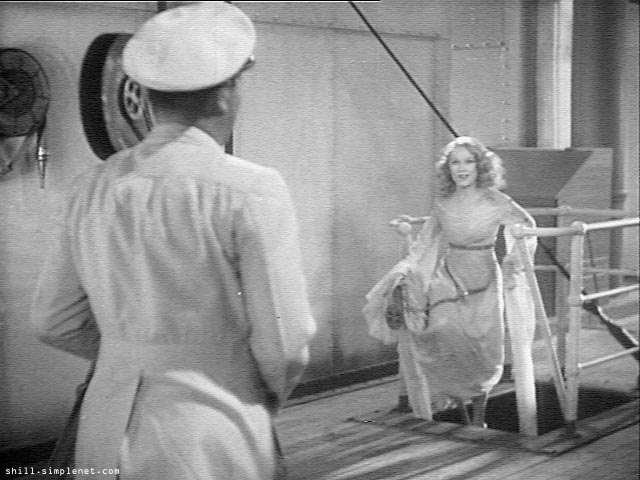
Slothrop, who is wearing a blonde wig and the same flowing white cross-banded number Fay Wray wears in her screentest scene with Robert Armstrong on the boat (considering his history in the Roseland toilet, Slothrop may have chosen this gown not only out of some repressed desire to be sodomized, unimaginably, by a gigantic black ape, but also because of an athletic innocence to Fay that he's never spoken of except to point and whisper, "Oh, look. . ." -- some honesty, pluck, a cleanness to the garment itself, its enormous sleeves so that wherever you pass is visibly where you've been. . .)
The "flowing white cross-banded number" may be this one. (Thanks to Otto Sell and Dave Monroe for the pynchon-l heads-up.)

tainted, coopted, and colonized, by the forces of Control, usually digital in nature

from the ACLU's summary of its recent report, The Surveillance-Industrial Complex:
“Recruiting Individuals.”  Documents how individuals are being recruited to serve as “eyes and ears” for the authorities even after Congress rejected the infamous TIPS (Terrorism Information and Prevention System) program that would have recruited workers like cable repairmen to spy on their customers.    

“Recruiting Companies.”  Examines how companies are pressured to voluntarily provide consumer information to the government; the many ways security agencies can force companies to turn over sensitive information under federal laws such as the Patriot Act; how the government is forcing companies to participate in watchlist programs and in systems for the automatic scrutiny of individuals’ financial transactions.    
 
“Mass Data Use, Public and Private.”  Focuses on the government’s use of private data on a mass scale, either through data mining programs like the MATRIX state information-sharing program, or the purchase of information from private-sector data aggregators.     

“Pro-Surveillance Lobbying.”  Looks at the flip side of the issue: how some companies are pushing the government to adopt surveillance technologies and programs based on private-sector data.

Thomas Pynchon, 1997, Introduction to Stone Junction:
The other day in the street I heard a policeman in a police car, requesting over his loudspeaker that a civilian car blocking his way move aside and let him past, all the while addressing the drive of the car personally, by name. I was amazed at this, though people I tried to share it with only shrugged, assuming that of course the driver's name (along with height, weight and date of birth) had been obtained from the Motor Vehicle Department via satellite, as soon as the offending car's license number had been tapped into the terminal -- so what?

Stone Junction was first published in 1989, toward the end of an era still innocent, in its way, of the cyberworld just ahead about to exponentially explode upon it. To be sure, there were already plenty of computers around then, but they were not quite so connected together as they were shortly to become. Data available these days to anybody were accessible then only to the Authorized, who didn't always know what they had or what to do with it. There was still room to wiggle -- the Web was primitive country, inhabited only by a few rugged pioneers, half loco and wise to the smallest details of their terrain. Honor prevailed, laws were unwritten, outlaws, as yet undefinable, were few. The question had only begun to arise of how to avoid, or, preferably, escape altogether, the threat, indeed promise, of control without mercy that lay in wait down the comely vistas of freedom that computer-folk were imagining then -- a question we are still asking. Where can you jump in the rig and head for any more -- who's out there to grant us asylum? If we stay put, what is left to us that is not in some way tainted, coopted, and colonized, by the forces of Control, usually digital in nature? Does anybody know the way to William Gibson's "Republic of Desire?" Would they tell if they knew? So forth.

tainted, coopted, and colonized, by the forces of Control, usually digital in nature

from the ACLU's summary of its recent report, The Surveillance-Industrial Complex:
“Recruiting Individuals.”  Documents how individuals are being recruited to serve as “eyes and ears” for the authorities even after Congress rejected the infamous TIPS (Terrorism Information and Prevention System) program that would have recruited workers like cable repairmen to spy on their customers.    

“Recruiting Companies.”  Examines how companies are pressured to voluntarily provide consumer information to the government; the many ways security agencies can force companies to turn over sensitive information under federal laws such as the Patriot Act; how the government is forcing companies to participate in watchlist programs and in systems for the automatic scrutiny of individuals’ financial transactions.    
 
“Mass Data Use, Public and Private.”  Focuses on the government’s use of private data on a mass scale, either through data mining programs like the MATRIX state information-sharing program, or the purchase of information from private-sector data aggregators.     

“Pro-Surveillance Lobbying.”  Looks at the flip side of the issue: how some companies are pushing the government to adopt surveillance technologies and programs based on private-sector data.

Thomas Pynchon, 1997, Introduction to Stone Junction:
The other day in the street I heard a policeman in a police car, requesting over his loudspeaker that a civilian car blocking his way move aside and let him past, all the while addressing the drive of the car personally, by name. I was amazed at this, though people I tried to share it with only shrugged, assuming that of course the driver's name (along with height, weight and date of birth) had been obtained from the Motor Vehicle Department via satellite, as soon as the offending car's license number had been tapped into the terminal -- so what?

Stone Junction was first published in 1989, toward the end of an era still innocent, in its way, of the cyberworld just ahead about to exponentially explode upon it. To be sure, there were already plenty of computers around then, but they were not quite so connected together as they were shortly to become. Data available these days to anybody were accessible then only to the Authorized, who didn't always know what they had or what to do with it. There was still room to wiggle -- the Web was primitive country, inhabited only by a few rugged pioneers, half loco and wise to the smallest details of their terrain. Honor prevailed, laws were unwritten, outlaws, as yet undefinable, were few. The question had only begun to arise of how to avoid, or, preferably, escape altogether, the threat, indeed promise, of control without mercy that lay in wait down the comely vistas of freedom that computer-folk were imagining then -- a question we are still asking. Where can you jump in the rig and head for any more -- who's out there to grant us asylum? If we stay put, what is left to us that is not in some way tainted, coopted, and colonized, by the forces of Control, usually digital in nature? Does anybody know the way to William Gibson's "Republic of Desire?" Would they tell if they knew? So forth.

Monday, August 09, 2004

residence in the injuring and corruptive world

The Guardian reports that Gabriel Garcia Marquez has sold the film rights to his novel, Love in the Time of Cholera, for two to three million dollars after years of hounding by Hollywood producer Scot Steindorff, who hints that the author may also be persuaded to write the screenplay.
This novel is also revolutionary in daring to suggest that vows of love made under a presumption of immortality -- youthful idiocy, to some -- may yet be honored, much later in life when we ought to know better, in the face of the undeniable. This is, effectively, to assert the resurrection of the body, today as throughout history an unavoidably revolutionary idea. Through the ever-subversive medium of fiction, García Márquez shows us how it could all plausibly come about, even -- wild hope -- for somebody out here, outside a book, even as inevitably beaten at, bought and resold as we all must have become if only through years of simple residence in the injuring and corruptive world.

from:
The Heart's Eternal Vow, review of Love in the Time of Cholera by Thomas Pynchon, 10 April 1988

what?

Today in History:
1974 - Richard M. Nixon resigns as President of the United States.

Gravity's Rainbow, p. 617:
What?
-RICHARD M. NIXON

Sunday, August 08, 2004

2 kinds of pynchon reader

Those who enjoy reading Lewis Carrol, and who will no doubt enjoy this Library of Congress online publication of his scrapbook, and those who don't.

Saturday, August 07, 2004

I will shoot them.

From BBC, Germany to attend Herero ceremony
A German minister will, for the first time, attend ceremonies commemorating the massacre of Namibia's Herero people by German soldiers 100 years ago. Germany's development minister, Heidemarie Wieczorek-Zeul, will take part in the event, scheduled to take place on 14 August at Okakarara. An estimated 65,000 Herero were killed there in 1904 during a rebellion against German colonial rule. It was one of the most significant battles between Germany and the Herero. The German military commander at the time, General von Trotha, ordered the Hereros to leave Namibia or be killed. "Any Herero found within the German borders with or without a gun, with or without cattle, will be shot. I shall no longer receive any women or children; I will drive them back to their people. I will shoot them. This is my decision for the Herero people," he said. Following their defeat, Herero men, women and children were killed, their wells poisoned, their cattle slaughtered and the survivors driven into the desert to die. Thousands fled to neighbouring Botswana. A group of Herero has filed a case for compensation against Germany in the United States. They are demanding $4bn in compensation, to be paid by the German government and by companies who they say benefited from slavery and exploitation under German rule. Germany has expressed "regret" for the killings, but the German ambassador to Namibia has called for the case to be dropped.

in the name of the cathode, the anode, and the holy grid

Secrets of ENIAC:
The Electronic Numerical Integrator and Computer (ENIAC) was among the very first computers—some say it was the first, though there are competing claims. Built at Penn from 1942 to1946, its work was the most prosaic imaginable: calculating missile ballistics and later helping with the design of the hydrogen bomb....For someone who came of age in the second half of the computer revolution, the immediately surprising thing about ENIAC is its physicality. It is a machine in the most literal sense, built from huge metal boxes, massive cables, thick copper wires joined by gobs of solder, panels full of dials, bank upon bank of vacuum tubes. Looking again, the second surprise is the beauty and intricacy of its individual parts. A single tube, responsible for just one numeral in a decimal ring counter, contains a thicket of wires, planes, and baffles. If you peer very closely, a microcosm of strange and enigmatic scenes begins to unfold. These images of ENIAC express the wonder I felt when, as a child, I came to understand what a computer is: not just a calculating machine, but a tool for amplifying imagination, making it possible to weave structures of pure abstract symbols and see them rendered as concrete things, real places. This is pure magic.
V., p. 404:
In his electro-mysticism, the triode was as basic as the cross in Christianity. Think of the ego, the self that suffers a personal history bound to time, as the grid. The deeper and true Self is the flow between cathode and plate. The constant, pure flow. Signlas--sense-data, feelings, memories relocating--are put onto the grid, and modulate the flow. We live lives that are waveforms constantly changing with time, now positive, now negative. Only at moments of great serenity is it possible to find the pure, the informationless sttate of signal zero.

"In the name of the cathode, the anode, and the holy grid?"

rainbow vision

European Space Agency:
Envisat's rainbow vision detects ground moving at pace fingernails grow
 
Originally developed to pinpoint attacking aircraft during World War Two, today's advanced radar technology can detect a very different moving target: shifts of the Earth's crust that occur as slowly as the growth of your fingernails. Radar data from satellites such as ESA's Envisat are used to construct 'interferograms' that show millimetre-scale land movements. These rainbow-hued images provide scientists with new insights into tectonic motion, and an enhanced ability to calculate hazards arising when this slow motion speeds up, in the form of earthquakes or volcanic activity....

Mason & Dixon, p. 172:
"Look to the Earth," she instructs him. "Belonging to her as I do, I know she lives, and that here upon this Volcanoe in the Sea, close to the Forces within, even you, Mopery, may learn of her, Tellurick Secrets you could never guess."

Friday, August 06, 2004

"the fireburst came roaring and sovereign"

Gravity's Rainbow p. 693:
... wirephoto of a giant white cock, dangling in the sky straight downward out of a white pubic bush. The letters

MB DRO
ROSHI


appear above with the logo of some occupation newspaper, a grinning glamour girl riding astraddle the cannon of a tank, steel penis with slotted serpent head, 3rd Armored treads 'n' triangle on a sweater rippling across her tits. The white image has the same coherence, the hey-lookit-me smugness, as the Cross does. It is not only a sudden white genital onset in the sky--it is also, perhaps, a Tree. . . .


See also:
Hiroshima Story and
In the Shadow of Hiroshima and Nagasaki: The Cultural Conditions of Unconditional Surrender

neverending windfalls of the War that Never Ends

Post-War Contractors Ranked by Total Contract Value in Iraq and Afghanistan From 2002 through July 1, 2004. Impressive numbers indeed, and the blood money seems likely to continue to roll in no matter how badly the contractors behave over there, too. Reuters reports:
CACI International Inc., under scrutiny over whether it contributed to the abuse of Iraqi prisoners, was awarded a $15 million extension of its work in Iraq, the U.S. Army said on Wednesday. The award allows CACI's work supporting interrogations and other intelligence operations to continue while competitive bids are sought on a new contract for these services, a senior Army contracting official said.
Gravity's Rainbow, p. 105:
Don't forget the real business of the War is buying and selling.

Thursday, August 05, 2004

They called him "the Kenosha Kid," though this may be apocryphal.

from An American Debate: How Severe the Threat?:
If the United States was in imminent danger of a terrorist attack and faraway financial institutions were supposed to be on high alert, there was no evidence of it at Franks Diner, a 78-year-old Kenosha institution where senators mix with regular folk and the prospect of another attack seemed just part of the background noise of daily life. "I don't know who on earth to believe anymore," said Michael Schumacher, a 54-year-old writer who was eating a bratwurst for breakfast. "You feel you're being manipulated all the time." Some version of that view was echoed at almost every table here as many patrons questioned whether the Bush administration was trying to manipulate the terrorist threat for political advantage.
Gravity's Rainbow, p. 61:
Superior (incredulously): You? Never! Did the Kenosha Kid think ..."


keep your eyes on the prize

...of interest, perhaps, to readers who try to map Vineland's political geography to the historical Movement:

Doing Time for Political Crime: Paul and Silas, Bound in Jail
Dave Gilbert helped form the Weather Underground. Without killing anyone, the Weather Underground bombed military and corporate targets, during the early 1970s....Dave Gilbert wrote, “any white movement worthy of the name ‘revolutionary’ had to take on the task of building an underground that could carry on armed struggle against this criminal government.” This is the writing of historical agency, but it is also writing from too long a stay in the wilderness. What is a revolutionary? What court could bring “this criminal government” to trial? What is a “white movement”? These questions were not answered, though they remain on the table. As for the meaning of “underground”, and “armed struggle,” the answers became clear.

What David did wrong happened in 1981 when Thatcher and Reagan were in power, and the prisons grew. In fact it was the year when the “golden gulag” was placed around the neck of the republic, as Ruth Gilmore shows. David Gilbert was arrested for his role as a driver in a notorious attempt to expropriate a Brinks money truck in Nyack, N.Y., in which two police officers and one Brinks guard were killed. As an accessory he is now serving a life sentence in the N.Y. state prison system, shunted about according to the whim and ways of the Department of Corrections - now Elmira, now Attica, presently Dannemora.

At the opening of his trial in September 1982 he said to the court which he and his co-defendants, Kuwasi Balagoon and Judy Clark, refused to recognize, “We are neither terrorists nor criminals. It is precisely because of our love of life, because we revel in the human spirit, that we became freedom fighters against this racist and deadly imperialist system.”

"you sixties people"

Artist, Katie Grinnan in an Artnet interview:
AFH: When you use the word "hippie" are you referring to the ideology in songs like Joni Mitchell's, "They paved paradise and put in a parking lot," or Chrissie Hynde's, "I went back to my city"? Hynde is not a hippie, but those songs seem to relate to your work. Don’t you consider "hippie" a pejorative description for political art? It seems that label is often used to make relevant statements sound anachronistic or too extreme?

KG: I disagree. I think because I was born in the 70's and missed the 60's I idealize the word hippie. I admire hippies because I associate them with freedom, open-mindedness, experimentation, revolution, peace and an uncorrupted attitude towards money.

AFH: You must be referring to the original hippies. Don't you find there to be something distressingly naïve about current-day hippies since that aesthetic and those ideals have been so mocked and commercialized by subsequent eras?

KG: Well, I really like the Easy Rider "we can live off the land" idea of a hippie, but it's a little disheartening when the song "Revolution" refers to Nike. I'm pretty fascinated with the way the meaning of the 60's has evolved. I don't think the term hippie would be used now. There isn't really a specific hippie style anymore and attitudes have shifted and broadened due to hindsight. They've fractured into multiple groups like environmentalists, the health conscious, organic farmers, political activists, anarchists...etc.. even yuppies.
Vineland, p. 28:
Caray, you sixties people, it's amazing. Ah love ya! Go anywhere, it don't matter -- hey, Mongolia! Go way out into smalltown Outer Mongolia, ese, there's gonna be some local person about your age come runnin up, two fingers in a V, hollerin, 'What's yer sign, man?' or singing 'In-A-Gadda-Da-Vida' note for note.

Funny and sad how the art establishment -- as represented here by the Artnet interviewer -- has come to adopt the view of the '60s counterculture promulgated, in Pynchon's novel, by a Reagan Administration DEA agent. This interviewer reminds pynchonoid of a Fox News commentator trying to bully a left-leaning interlocutor.

Wednesday, August 04, 2004

the desert was prophecy enough

Heicheng, the largest and best preserved ancient city site along the Silk Road that linked China with Central and Western Asia, is being devoured by flowing sand.
from: Ancient city site in Inner Mongolia jeopardized by sand

V., chapter III, section V:
The only Mahdi is the desert. Mohammed Ahmed, the Madhi of '83, was believed by some to be sleeping not dead in a cavern near Baghdad. And on the Last Day, when the prophet Christ re-establishes el-Islam as the religion of the world he will return to life to slay Dejal the antichrist at a church gate somewhere in Palestine. The Angel Asrafil will trumpet a blast to kill everything on earth, and another to awaken the dead. But the desert's angel had hidden all the trumpets beneath the sand. The desert was prophecy enough of the Last Day.

if you're not disgusted, you're not paying attention

Yesterday's reference to Brigadier Pudding, now a worth-reading Martha Nussbaum article (source of the quote below) on disgust reminds me that the Pudding content of Gravity's Rainbow reportedly led judges to deny that fabulous novel a Pulitzer Prize way back when.
In the early 20th century, for example, James Joyce's Ulysses was attacked as obscene. Often complaints focused on its frank depiction of a woman's nonmarital sexual desires (in Molly Bloom's famous monologue, combined with ruminations about her menstrual period, deflationary thoughts about the penis, and memories of love). Joyce believed that our disgust with our own bodily functions lay at the root of much social evil -- nationalism, fanaticism, misogyny. Like D.H. Lawrence, he held that a healthy society would be one that came to grips with its own mortal bodily nature. Joyce's novel, of course, is the opposite of disgusting to one who reads it as it asks to be read. It presents the body as an object of many emotions -- desire, humor, tender love, calm acceptance. But one emotion that is conspicuously absent from its invitation to readers is the emotion of disgust....


the real business of the War

CACI, one of the companies that supplied interrogators at the heart of the Iraq prison torture scandal, says profits are mushrooming thanks to new business opportunities in the Iraq war. "Iraq is a very fertile opportunity for growth," says CACI's CEO, who faced grilling from California legislators upset about the company's activities in Iraq, in hearings regarding investment in the firm by the state's two largest public pension funds, according to an article in today's San Francisco Chronicle.

Gravity's Rainbow, p. 105:
Don't forget the real business of the War is buying and selling.

Tuesday, August 03, 2004

what Paul learned from Pudding


Fussell was vigorously opposed to last year's invasion of Iraq: "If you don't get angry about this war you don't deserve to be alive." Under no illusions about the cruelty of frontline troops (in Doing Battle he describes how his own platoon murdered weeping, surrendering German soldiers, and elsewhere reflects on the fashion among American troops in the Pacific for collecting Japanese skulls), he regards the torture of Iraqi prisoners as "absolutely predictable - it's usually practised by soldiers upon each other". Sadism, he says, is ordinary in war: "That's why it has to be so carefully guarded by rules - the Geneva convention and so on."

"The greatest irony," Fussell wrote at the end of The Great War, "is that it is only now [after the relaxation of censorship in the 60s], when those who remember the events are almost all dead, that the literary means for adequate remembering and interpreting are finally publicly accessible." In a close reading of Thomas Pynchon's Gravity's Rainbow, he picked out Brigadier Pudding, tormented by the image of Passchendaele and its "shell-pocked leagues of shit in all directions", for whom ritualised sexual humiliation becomes a compulsive means of remembering. When OUP asked Philip Larkin for a comment on Fussell's book, the poet called this final section "obscene nonsense". Fussell, who went further than most in his discussion of the profound damage, to minds as well as bodies, that could be the long-term effect of war, says: "It strikes me as almost cruel, to write about the last seconds of the lives of young people who are scared to death, as if war were a matter of battalions and staff organisations and so on. It's unimaginative, hopeless - it doesn't do any good."

...from:
Hello to all that, interview with author Paul Fussell

Tuesday, July 27, 2004

proof you can link anything to Thomas Pynchon?

This lead from an article in Inside Triathalon:
In Thomas Pynchon's novel Vineland, coastal Northern California is a haunted land of dripping redwood forests and leftover hippie enclaves from the 1960s. The hippie enclaves have mostly been replaced by wineries, spas and expensive boutiques, but the forests are deep as ever. And western Sonoma County this weekend hosts one of the premier age-group long-course triathlons in North America.

Monday, July 26, 2004

A MOMENT OF FUN WITH TAKESHI AND ICHIZO, THE KOMICAL KAMIKAZES

Ooka, who is perhaps best known in the West for the novel Nobi (1951), translated by Ivan Morris as Fires on the Plain (1957), and the memoir Tsukamaru made (1948), epitomized the Japanese recruit of the latter days of the Pacific War; he was ill-trained, badly commanded, and largely abandoned by the central military bureaucracy. Conscripted in 1944 at the age of thirty-five, Ooka received three months of basic training and was subsequently sent to the front where he served as his battalion's communications man until his battalion was routed and numerous men killed. Captured in late January 1945, he was one of the few who survived, possibly because of his capture and ensuing imprisonment. Survival was very traumatic for Ooka, who was troubled that he, an unworthy soldier, had survived when so many others had not. Stahl's provocative book suggests that Ooka only began to process his guilt feelings in early, overtly autobiographical works, and that this process was actually the theme that grounded his postwar writing career. Stahl posits that writing became Ooka's survivor mission, allowing him first to process and then to come to terms with his own survival, by working through issues related to the collective Japanese war experience. ....through writing, Ooka served as a voice for the dead and those who could not speak and also as a moral conscience for the Japanese people in the process of remembering the war. In the process, Ooka also healed himself.
Memory, Guilt, Mourning and Responsibility: A Writer's Pilgrimage
by Patricia Welch, review of
The Burdens of Survival: Ooka Shohei's Writings on the Pacific War by David C. Stahl

Gravity's Rainbow, p. 691:
On moonless or overcast nights, Takeshi and Ichizo take off all their clothes and splash each other with Cypridina light, running and giggling under the palms.

Sunday, July 25, 2004

Gravity's Rainbow as fodder for 12-year old sci-fi fanatics?

Movie reviewer puts Gravity's Rainbow in science-fiction catgegory in I, Robot review.

Thursday, July 22, 2004

the joy of reading Pynchon

"Kids that can't read don't ever get the opportunity to: (a) See subtitled Chow Yun-Fat movies, (b) Read their own Bazooka Joe comics, (c) Start but never finish a Thomas Pynchon novel and (d) Find out what happened between the randy tennis pro and the eager students in the July 1988 edition of Penthouse Forum," reports the Las Vegas Mercury. The newspaper urges readers to volunteer to help children learn to enjoy reading.

Tuesday, July 20, 2004

new article on Mason & Dixon

...from pynchon-l:

A Patch of England, at a three-thousand mile off-set"? Representing America in Mason & Dixon
by Stacey Olster, 1 July 2004, Modern Fiction Studies 283, Volume 50; Issue 2
Thomas Pynchon's Mason & Dixon ends with the death of Charles Mason in 1786 and the decision of his two eldest children to stay in Philadelphia and "be Americans." As to what constitutes that nationality, however, Pychon remains silent, writes Olster. Here, she discusses the literary representation of America in relation to the colonial England in Pynchon's novel.

Monday, July 19, 2004

shooting electricity

A holy man in northern India says drugs don't cut it, he has to touch live electricity wires every day to get his fix, Ananova reports:
Sadhu Mangal Das alias 'Current Baba', touches a naked wire at least three times every day to become 'intoxicated'. It's reported he brushed against a live wire sometime ago and found the sensation to be so good he can no longer do without his daily dose. The man from Bahorisar in Uttar Pradesh said he tried the electricity wires because drugs failed to excite him, says The Hindustan Times. The 54-year-old also tried getting bitten by snakes and scorpions. He also tried drinking potions made from poisonous seeds. Dr Amit Chaturvedi of the Lalitpur Civil Hospital said: "The human body can absorb currents up to 12 volts. In this case however, repeated exposure to electricity seems to have built up his body's tolerance levels to as much as 16 volts."
Gravity's Rainbow, p. 698:
Son, been wondering about this, ah, "screwing in" you kids are doing. This matter of the, shooting electricity into head, ha-ha?
Mason & Dixon, p. 286:
"A childhood Misadventure with a Torpedo," Dixon, with a brief move of his toward Mason, confides,"--thus his Sensitivity at all References to the," -- whispering,-- "electrickal!"
V., p. 78:
Bongo-Shaftsbury smiled. He rolled up the shirt cuff and thrust the naked underside of his arm at the girl. Shiny and black, sewn into the flesh, was a miniature electric switch. Single-pole, double-throw. Waldetar recoiled and stood blinking. Thin silver wires ran from its terminals up the arm, disappearing under the sleeve.
"You see, Mildred. These wires run into my brain. When the switch is closed like this I act the way I do now. When it is thrown the other--"
"Papa!" the girl cried.
"Everything works by electricity. Simple and clean."

"Why did Bush knock down the towers?"

Jadakiss asks.

Till the Light that hath brought the Towers low Find the last poor Pret'rite one...
Gravity's Rainbow, p. 760

Sunday, July 18, 2004

Germany avoids Herero reparations

BBC NEWS:
Germany has rejected calls to pay compensation for the killing of thousands of Namibia's ethnic Hereros during the colonial era. The German ambassador to Botswana told a gathering of Hereros in northern Botswana that Germany deeply regretted what he called "this unfortunate past". However, he said it was not prepared to offer reparations.

Some 1,000 Hereros were there to mark the killing of their ancestors who rebelled against German rule in 1904. They used the meeting to renew demands for $4bn in compensation, to be paid by the German government and by companies who they say benefited from slavery and exploitation under German rule.

But Ambassador Hans-Dietrich von Bothmer said German development aid was intended to benefit all Namibians, not just one ethnic group. Correspondents say Mr von Bothmer's speech was virtually identical to one delivered by his counterpart in Namibia, Wolfgang Massing, at a previous ceremony in January.

Between 35,000 and 105,000 of the Hereros living in Namibia lost their lives in the 12 January 1904 massacre, while thousands of others fled to neighbouring Botswana.

the hacker we call God

Revelation Space, Alastair Reynolds, p. 560:
...Calvin had shared all that he had felt, or that for a moment their thoughts--and more--had liquified and flowed indivisibly, along with a trillion others. And that he understood perfectly what had happened, because in the moment of shared wisdom, all his questions had been answered.
"We were read weren't we? .... For a moment I think we were linked to every other piece of information ever known; every thought ever thought, or at least ever captured by the light."
"A computer," Calvin said...."That's what Hades is. A computer made out of nuclear matter, the mass of a star devoted to processing information, storing it. And this light is an aperture into it; a way to enter the computational matrix.
Vineland, pp. 90-91:
If patterns of ones and zeros were "like" patterns of human lives and deaths, if everything about an individual could be represented in a computer record by a long string of ones and zeros, then what kind of creature would be represented by a long string of lives and deaths? It would have to be up one level at least - an angel, a minor god, something in a UFO. It would take eight human lives and deaths just to form one character in this being's name - its complete dossier might take up a considerable piece of the history of the world. We are digits in God's computer, she not so much thought as hummed to herself to a sort of standard gospel tune. And the only thing we're good for, to be dead or to be living, is the only thing He sees. What we cry, what we contend for, in our world of toil and blood, it all lies beneath the notice of the hacker we call God.
Gravity's Rainbow, pp. 650-651:
Anyone shows us the meanest hope of transcending and the Committee on Incandescent Anomalies comes in and takes him away. Some do protest, maybe, here and there, but it's only information, glow-modulated, harmless, nothing close to the explosions in the faces of the powerful that Byron once envisioned back there in his Baby ward, in his innocence.


Friday, July 16, 2004

TRP returns to The Simpsons

That's what Fox says. (Thanks to Rich of PYNCHON-L for the heads-up.)

Thursday, July 15, 2004

"tainted, coopted, and colonized, by the forces of Control"

From a Paul Weinberg column about the impact on civil liberties that US Homeland Security actions are having on Canadian citizens:
Earlier this month, for instance, CNN reported that police officers across the United States are carrying handheld wireless computers on which they can access private details from large commercial databases about anyone they encounter on their beat. Emboldened by a new post-Cold War role in the U.S.-led "war on terrorism," security and intelligence agencies are exploring new electronic technologies that will enhance the collection and dissemination of the private records of citizens across international borders. "It's all about data gathering and integration of databases, information sharing and risk assessment by computer generated profiling," says Roch Tassé, coordinator of the Ottawa-based International Civil Liberties Monitoring Group (ICLMG), a coalition made up of NGOs, churches, unions, environmental and civil rights advocates and groups representing immigrant and refugee communities in Canada.
Thomas Pynchon, 1997, Introduction to Stone Junction:
The other day in the street I heard a policeman in a police car, requesting over his loudspeaker that a civilian car blocking his way move aside and let him past, all the while addressing the drive of the car personally, by name. I was amazed at this, though people I tried to share it with only shrugged, assuming that of course the driver's name (along with height, weight and date of birth) had been obtained from the Motor Vehicle Department via satellite, as soon as the offending car's license number had been tapped into the terminal -- so what?

Stone Junction was first published in 1989, toward the end of an era still innocent, in its way, of the cyberworld just ahead about to exponentially explode upon it. To be sure, there were already plenty of computers around then, but they were not quite so connected together as they were shortly to become. Data available these days to anybody were accessible then only to the Authorized, who didn't always know what they had or what to do with it. There was still room to wiggle -- the Web was primitive country, inhabited only by a few rugged pioneers, half loco and wise to the smallest details of their terrain. Honor prevailed, laws were unwritten, outlaws, as yet undefinable, were few. The question had only begun to arise of how to avoid, or, preferably, escape altogether, the threat, indeed promise, of control without mercy that lay in wait down the comely vistas of freedom that computer-folk were imagining then -- a question we are still asking. Where can you jump in the rig and head for any more -- who's out there to grant us asylum? If we stay put, what is left to us that is not in some way tainted, coopted, and colonized, by the forces of Control, usually digital in nature? Does anybody know the way to William Gibson's "Republic of Desire?" Would they tell if they knew? So forth.

Map v. territory

Tourist got lost following 1914 guide book:
An elderly American tourist had to be rescued in Germany after he got lost while using a 90-year-old guide book. Hank Edwards, 79, ended up stuck in a German forest for two days after finding his way with a book bought by his father in 1914. Throughout the years he kept the book, practising the German words and studying the places mentioned in the copy of Beautiful Bayreuth. When he was finally able to make the trip, he got lost trying to find attractions that had long since disappeared.... "It's still very beautiful here even if it's not what he expected."
Mason & Dixon, p. 141:
Occasionally Insanty roll'd a sly Eye-ball into the picture. Treatises on "parageography" arriv'd, with alternative Maps of the world superimpos'd upon the more familiar ones.
Thomas Pynchon, Introduction to Slow Learner:
That old Baedeker trick again.

Wednesday, July 14, 2004

A screaming comes across the sky....

Under Fire, in collaboration with a group called V2:
a year-long project that explores the organization and representation of contemporary armed conflict. The project consists of a series of organized discussions that will occur online and in Rotterdam, throughout the year 2004. The discussions will involve participation from individuals working in politics, theory, criticism, the arts, and journalism from both the West and the Middle East. A series of publications will be released during the course of the year.
Thanks to NEWSgrist for the heads-up.

....It has happened before, but there is nothing to compare it to now....

Strength through Joy

...from a review of Shelley Baranowski's Strength through Joy: Consumerism and Mass Tourism in the Third Reich:
.... the Nazis' popular leisure organization, "Strength through Joy" (_Kraft durch Freude_, or KdF) .... in many ways reinforcing the recent historiographic emphasis on popular consent to Nazi rule, yet also complicating the picture through its focus on a variety of deep-seated, overlapping tensions--between individual desires and collective welfare, between sacrifice and pleasure--that so strongly molded "racially valuable" Germans' experiences of the regime.... Rejecting both the Marxist vision of collective entitlement and the "Fordist" model of standardized production and high wages, the Nazis attempted to construct a distinctly "German" model of consumption free from the rampant individualism and shallow materialism associated with America, yet willing to reward individual talent and performance so long as it served the interests of the "racial community." ....As by far the most popular aspect of the Nazi regime, and as nothing less than its answer to the conundrum of "guns or butter," KdF mushroomed into a sprawling network of package tours, theater tickets, cruise ships and film discounts, gradually occupying the vast bureaucratic space that opened up between the concrete imperatives of rearmament and the overarching aim of reducing class conflict and the appeal of Marxism. Yet as the third chapter demonstrates, the development of KdF was not all fun and games. Its "Beauty of Labor" (_Schönheit der Arbeit_) program clearly reflected the Nazi adherence to a productivist vision of leisure as inseparable from work....Although the outbreak of the war in 1939 severely curtailed KdF's tourism offerings, the organization nonetheless served the war effort by providing entertainment for troops and civilians alike.... KdF contributed significantly, if indirectly, to the rapacious and racist mentality that so characterized the Nazi occupation of Europe, encouraging territorial expansionism, furnishing both motive and alibi for plunder, and eventually abetting mass murder.

...from Gravity's Rainbow, p. 419:
In a corporate State, a place must be made for innocence, and its many uses. In developing an official version of innocence, the culture of childhood has proven invaluable. Games, fairy-tales, legends from history, all the paraphernalia of make-believe can be adapted and even embodied in a physical place, such as at Zwolfkinder. [...] From Peenemunde they had come 280 kilometers, which was to be, coincidentally, the operational range of the A4.

Monday, July 12, 2004

Baseball the pynchonoid way

As the pennant races begin to heat up, pynchonoid loves knowing that several current major league managers played minor league games at a place called...here it comes... Pynchon Park. Reports The Republican sports writer, Garry Brown:
The list is led by Felipe Alou, revered manager of the San Francisco Giants. In 1957, his second season as a professional, he played for the Eastern League's Springfield Giants at Pynchon Park. Two others played at Pynchon as visitors: Tony LaRussa of the Cardinals, with Binghamton in 1962; and Lou Piniella of Tampa Bay, with Elmira in 1965 (the last year of professional baseball in Springfield).

Sunday, July 11, 2004

Headline writer reveals pynchonoid tendencies

VINELAND
A tale of two Pichons
Winemakers do battle on the same estate


....You can read the rest of William Campbell's article in Japan Times.

Friday, July 09, 2004

What if?

...from "Might the Mayflower Not Have Sailed?" by Theodore K. Rabb, in What Ifs of American History: Eminent Historians Imagine What Might Have Been pp. 1-16:
....what if one of the circumstances had not fallen into place and she had not planted a 'godly' community at Plymouth? That question leads us to the crucial moment for the long-term success of the colony: the arrival from England in 1630 of John Winthrop, a Puritan lawyer, with a fleet of eleven ships carrying some seven hundred colonists. Would they have come if the Mayflower had not preceded them can be argued that they would not.... Without the beacon planted at Plymouth to reassure them, these staid, comfortable, and conservative creators of a 'Bible Commonwealth' would scarcely have risked their families and their possessions on so hazardous an enterprise. Again one must say that without the Mayflower, there could have been no Massachusetts Bay. " .... It was thus a combination of belief and circumstances that enabled the Puritans to inject into American culture an expectation of religious faith, a commitment to self-reliance and daily toil as morally worthy, and a stern regard for the virtuous life that have given their country a quite distinctive coloration among the modern nations of the West.... We may now take for granted the role of these traditions--the force of religion, the equation of work with virtue, the focus on the individual, and the insistent devoutness alongside the tolerance--in detrmining the course of American history. But there is little doubt that they might well have died in infancy if the Mayflower had not set sail...."

Tim Ware's fabulous ThomasPynchon.com:
William Pynchon is Thomas' colonial descendant, born in Springfield, Essex, England on 11 October 1590. He married Anne Agnes Andrew about 1623. The family emigrated to New England on Winthrop's fleet of 1630, Anne dying soon after their arrival. A few years later, William married Frances Sanford of Dorchester. William was the founder of Springfield, Massachusetts and one of the Bay Colony's leaders until his publication of a book about justification and redemption, The Meritorious Price of our Redemption (1650).

Gravity's Rainbow, p. 556:
"Could he have been the fork in the road America never took, the singular point she jumped the wrong way from? Suppose the Slothropian heresy had had the time to consolidate and prosper. Might there have been fewer crimes in the name of Jesus, and more mercy in the name of Judas Iscariot?"
(Thanks to Dave Monroe, for posting a slightly different version of this at Pynchon-l).

Thursday, July 08, 2004

It's "V period"

In case you're in this Kentucky neighborhood:
The Second Monday Book Club will discuss V by Thomas Pynchon at 6:30 p.m. Monday at the Madison County Public Library in Berea, 319 East Chestnut Street.

Wednesday, July 07, 2004

Tendrils alert

Daniel Albright, in Modernism and Music, quoting Arnold Whittal, Schoenberg Chamber Music:
When a hostile critic said of the young Schoenberg's sextet Verklarte Nacht (1899) that "it sounds as if somehone had smeared the score of Tristan while it was still wet," he provided a clever description for the Jugenstil (or art nouveau) way in which Schoenberg's melodies seem to curl themselves in continuous tendrils, instead of pausing on harmonically significant notes.

Thomas Pynchon, intro to Slow Learner:
I will spare everybody a detailed discussion of all the overwriting that occurs in these stories, except to mention how distressed I am at the number of tendrils that keep showing up. I still don't even know for sure what a tendril is. I think I took the word from T.S. Eliot. I have nothing against tendrils personally, but my overuse of the word is a good example of what can happen when you spend too much time and energy on words alone.

Tuesday, July 06, 2004

"New York NY 10001"

One pynchon-l participant asked about the current address for Melanie Jackson's literary agency, and received the following reply (links added):
Curious, I tapped her up on anywho.com, and see that she no longer lists a street address, just "New York NY 10001" That zip code is, of course, the main post office opposite Mad Sq Gdn. It is a gargantuan classical building by McKim Mead & White, and it sports the text frieze "Neither rain nor sleet nor snow stays these couriers" etc etc *and* ... wait for it ... the names Thurn und Taxis. Its a shame, but it seems we've driven Melanie, Tom and Jackson even further underground. Contact her through W.A.S.T.E.
Vineland, pp. 90-91:
If patterns of ones and zeros were "like" patterns of human lives and deaths, if everything about an individual could be represented in a computer record by a long string of ones and zeros, then what kind of creature would be represented by a long string of lives and deaths? It would have to be up one level at least - an angel, a minor god, something in a UFO. It would take eight human lives and deaths just to form one character in this being's name - its complete dossier might take up a considerable piece of the history of the world. We are digits in God's computer, she not so much thought as hummed to herself to a sort of standard gospel tune. And the only thing we're good for, to be dead or to be living, is the only thing He sees. What we cry, what we contend for, in our world of toil and blood, it all lies beneath the notice of the hacker we call God.

Monday, July 05, 2004

Nazis, Pynchon, and queers, oh my!

Nazis killed thousands of gay people in death camps and mistreated many more, but "Many of the leading European fascists of the past thirty years have been gay," reports self-described gay progressive activist Johann Hari in a recent article, The strange, unexplored overlap between homosexuality and fascism .

Gravity's Rainbow [665-666]:
They are 175s--homosexual prison-camp inmates. They have come north from the Dora camp at Nordhausen, north till the land ended, and have set up an all-male community between this marsh and the Oder estuary. Ordinarily, this would be Thanatz's notion of paradise, except that none of the men can bear to be out of Dora--Dora was home, and they are homesick. Their "liberation" was a banishment. So here in a new locationa they have made up a hypothetical SS chain of command--no longer restricted to what Destiny alloted then for jailers, they have now managed to come up with some really mean ass imaginary Nazi playmates

...from "Homoerotic Bonding as Escape from Heterosexual Responsibility in Pynchon's Slow Learner", by Mark Hawthorne:
In the stories collected in Slow Learner (1984) and in the uncollected "Morality and Mercy in Vienna" (1958), Thomas Pynchon deconstructs expectations of dominant male sex roles. He contrasts these expectations to fictional worlds where male protagonists consistently retreat from expected heterosexual responsibilities. Like Sal Paradise in Kerouac's On the Road (1957) and Gnossos Pappadopoulis in Richard Farina's Been Down So Long, It Looks Like Up to Me (1969), these protagonists retreat from women and social responsibilities by seeking the safety of intense male bonding. Though none of these authors directly suggests that the bonding may become genital (leaving that theme to Allan Ginsberg and William Burroughs), each constructs texts that call for decoding even while they insist that the subtextual eroticism is illusory. Balanced between desire and the desire to hide desire, the texts close in on themselves and create worlds of escape that deny their own foundations and thereby remain threatened by the rea l world that wants to collapse them.

Hawthorne's article, "Hi! My Name Is Arnold Snarb!': Homosexuality in The Crying of Lot 49", in Pynchon Notes 44-45, is also worth reading, but doesn't appear to be online.

Sunday, July 04, 2004

The Crying of Lot 444

A first edition of V. signed by the author sold at auction (link includes pix) for $10,200 last month. Regarding the inscription, Sotheby's notes:
"9/29/63 To my friend Bart, whether he reads it or not—Tom." Bart, the father of the present consignor, worked with Pynchon at Boeing in the early 1960s. Although thirty first editions of V., including advance reading copies, are recorded in American Book Prices Current, only one of those was signed by the notoriously reclusive Pynchon.

pynchonoid notes that Sotheby's characterization, "notoriously reclusive," is one with which Pynchon would likely disagree, based on his past public statement re the r-word. Thanks to a pynchon-l participant for the heads-up.

UPDATE: "it's all theatre"

Updating the earlier "it's all theatre" post, Robert Fisk reports on the U.S. effort to censor
Saddam's day in court.